Tuesday, 3 June 2014

Web Analytics


If you are following this blog post, you will notice I have jumped the category Web2.0. After reading the info several times, I can't get my head around it. So this week I am focussing on Web Analytics and next week I will finalise the blog entries with Week 11s subject.


There is a whole vocabulary out there in the analytical world. The information I will be covering today are fairly easy, user friendly terms.

Using Just Frame Kits as a case study, we can see that the following information.

Sessions - 142
The amount of sessions equates to the Total number of Sessions within a particular time frame. A session is the period time a user is actively engaged with your website.

Users - 128
Users that have recently vistied the site. This includes both new visits and users that are return guests.

Page views - 219
Page views is the total number of pages viewed on the website. Repeated views of a single page are also counted.

Pages - 1.54
Pages is the average number of pages viewed during a session. Repeated views of a single page are counted.

Duration - 1.31
The average length of a vistiors stay on the page

Bounce rate - 69.01
Bounce Rate is the percentage of single-page visits. This is the rate at which a person leaves your site from the entrance page without interacting or visiting any other pages within the site.

The traffic to the page is predominantly from Australia, with 140 visits and 98.59% of the vistis being from within the country. Only one person 0.70% visited the page from the United States. One other oerson also vistied the site, however the location was not listed.

The top three browsers used to access the site is;
1. Safari - 45
2. Internet explorer- 38
3. Chrome - 37

It is quite impressive what can be tracked, age, gender, how long they visit, what pages they visit and for how long. I'm sure it will only be a matter of time till we can find out how these people have their coffee!

Here is a list of definitions of a variety of techy analytical words. Enjoy!

High bounce rate: This is the length of time someone stays on your web page, or in this case, it is how quickly they leave your web page.

Average page depth: This tells you how many pages a guest visited whilst on your website.

Click through rate: The success of an email or ad campaign online is calculated by the amount of people that click through, taking you from the web page you are on to the ad that you selected.

Click: A click is the amount of times someone has clicked onto an ad or a feature on your web page.

Hyperlink: This is a link between two sites. For example you may click on an ad on a website and that links you to the advertisers website.

URL: Uniform resource locator. This is the way a resource is recognised online.

There is no end to the information that can be garnered from Analytics. I have only touched the surface.

Thanks for reading!

Unique visitors
 

Sunday, 11 May 2014

Channel conflict

                                                         Source: http://blog.seattletimes.nwsource.com

We have a fair bit of channel conflict in our house. My kids want ABC2 or 3, I want food shows, my hubbie wants footy......oh hang on, I just read the brief and it seems I may be off track. For those of you like me, who could be forgiven for thinking channel conflict is related to the television, let me tell you exactly what it is.

Channel conflict is when a business decides to engage by selling directly to the consumer, at the same time retailers/ distributors are also attempting to sell their product through other avenues. It makes sense that this would create some disharmony, particularly when a business has heavily relied on that middle man to create sales previously.

The Microsoft situation is an interesting one. Basically it would seem that Microsoft had a case of the greedy guts and wanted more than one slice of the pie (an apple pie it would seem), they created a tablet in direct competition to the Ipad, a product that currently uses the operating system Microsoft creates.

I don't think this kind of behaviour is uncommon and their are a number of organisations doing it quite successfully. Dell has made the reverse transition and gone from exclusive online sales to both online direct and utilising retail stores. There are certainly still a percentage of people that prefer to touch and feel a product before investing their cold hard cash.

I am personally surprised this tablet got off the ground given the feelings expressed by some fairly influential people in the industry and connected to Microsoft.

Without knowing the term channel conflict previously, I am aware of it in a very practical sense. I have just recently wound down a small biscuit business called The vintage baker. I stocked in stores around the Goldfields region and in Melbourne and also did markets. I was always wanting to ensure no conflict was created with my stockists. I always ensured if I had markets within their vicinity, then part of my marketing included making people aware that there were places locally they could purchase my products. I also had to ensure my pricing didn't undercut theirs.


In my opinion whether it is a small or large business choosing this method, the most important aspects of the process is relationships and communication. It would seem Microsoft were fairly illusive with the details and therefore placed strain on relations and a level of trust was lost.

Wednesday, 7 May 2014

Auctions & dynamic pricing


Ebay is by far the most recognisable and most heavily used online auction site in the world. I think we would be hard pressed to find someone who had not used Ebay, either as a buyer or a seller. I have used it for both. I have been trying to think of a great experience and a terrible experience to highlight the pros and cons of such a site but am struggling. To be honest the best purchases I have made in the last couple of years have been from my local tip shop!

As a bit of side information, Ebay was first called Auctionweb, from there the founder went to register the business as Echo Bay Inc, but it was taken. So on the spot, founder Pierre Omidyar came up with Ebay!


The Ebay business model is consumer to consumer, via the internet. There are no limitations in relation to access, all members, both buyers and sellers have an opportunity to view and bid on all available items for sale. Ebay operates as a broker (Rappa, 2009). The Ebay business model has no inventory, low capital expenditure and global reach decreases geographical boundaries. (Lillie, 2006).
Ebay has taken the common garage sale and bought it into the 21st century. Rain, hail or shine, relaxing in bed or quietly at work while no one is looking. People have the flexibility to bid no matter where they are.

Why are they so successful? many say it is because of their first mover advantage. Meaning they were the first of their kind. It was a novelty for many and now it is a daily ritual for some. They continue to care about their community with upgrades and feedback options. The variety of things you can purchase is like no where else and the site is always up and running, meaning their back end is efficient.

For a long time the small starting price on items was appealing and the primary method for listing items. The tables have now turned and in 2010 59% of transactions were using the fixed price "Buy it now" model.

One of the biggest areas for Fraud for Ebay users is fraudulent emails and websites, better known as 'Spoof' websites. Ebay have a number of great resources for users to read through, they also have an online community forum where you can comment on your experiences. Most importantly Ebay have a great relationship with Paypal. Using Paypal to pay for your transaction provides you with a safety net in many cases.

This morning I logged onto Ebay to  have a look around as it has been a few months since I have made any transactions and I was quite impressed by the amount of slick designer brands advertising on the home page. I think this is quite a smart move. For a lot of people shopping online is becoming the preferred way to buy things and if the general population are anything like me then, sometimes we might head to Ebay just to window shop, before you know it you end up with a pair of samurai swords you never knew you needed.
There is a spontaneous element to shopping on Ebay, so why wouldn't the major brands want to leverage off that. If you can buy all you need an only navigate one page, it is ideal.

I predict it is only a matter of time before Coles, Woolworths and Bunnings get on board


References

http://teamcaffeine.wikidot.com/a2-final

http://mashable.com/2010/08/07/ebay-facts/

McGraw, Hill, Irwin, (2008) E Business, Amazaon.com, not your average bookstore


Wednesday, 23 April 2014

Automata


Automata - It all sounds very dark and dramatic doesn't it?

This is Latin for: Self operating machines. I am personally dubious as to whether the Latin language so long ago really had a word for 'Self operating machines' or whether some guy just decided to tell people that.

Ever heard of a Cybertwin? No, I hadn't either until this week. Let me tell you Ian's Cybertwin needs some work. He was not helpful in the slightest. Cyber Ian let me know that he was not interested in hearing all about me and when I asked him a question, he responded by asking me where Iran was located. There was definitely something lost in translation and it is fair to say we are a long way off having a Cybertwin attending to all of our more tedious jobs.


Alan Turing was certainly ahead of his time when he came up with the concept of a machine that can exhibit intelligent behaviour, that of which would be indistinguishable from humans.
Based on Turings concept there was a test known appropriately as the Turing test. Basically, a human judge conducts a conversation using natural language, with humans and computers in a separate room. If the judge cannot distinguish between the machine and the human, congratulations, the machine has passed the test.

There have been mixed reactions to Turings test. The test fails to check on the ability to give correct answers and bases it completely on how the answers resemble typical human answers.

On the flip side Searle (1980) disagrees with the effectiveness of the Turing test, his argument being that the test does not prove that a computer can think. I tend to agree with him, however going forward I do believe the technology will get to a point where we can teach computers to think. World domination is only a click of a button away. Mwahahahahahahaha (cue evil laugh)

A good example of this in todays world is the introduction of Siri to Apple products. she is a virtual customer service agent that is trained to interact with you in a human style to the best of her ability. I do utilise her quite a bit. In particular for weather and directions. When she works well, I love her, when she doesn't understand me and she comes back with somewhat patronising answers, I want to throw my new friend right out the window!

It is a great instant option and it is exciting to think how that technology will develop in the next ten years. I think it will become a very viable option for businesses to utilise on a regular basis.

I imagine Alan Turing would have a great laugh at the movie that has just come out called "Her" where a young guy falls in love with his operating system. Will this be the new E Harmony?

http://www.youtube.com/watch?v=WzV6mXIOVl4

Watch this space.

P.S can I just say I found the quote from Tim Berners-Lee so self indulged. That last line where he says, "The day to day mechanisms will be handled by agents, leaving humans to provide the inspiration and intuition" We humans are just that good. hehe we as a race have a fairly high opinion of ourselves don't we?

Tuesday, 15 April 2014

Markets & Market Places


I have always wanted to go to the Markets or Souks as they are known in Marrakesh, Morocco. The thought that trade has been going on for such a long time here and the vivid colours and the sounds and smells would be exhilarating. I wonder how many of the stall holders have adopted an online presence?


My discussion on Question 1.

I go through phases when online shopping is something I do regularly and then I will revert back to the physical process. There is something so satisfying about touching, feeling and walking away with a product. This is one down side to online shopping.
I am a big fan of organic fruit and veg, however honestly when I am at Coles or the local green grocer, the price point often plays a part in my decision making process. More often than not, when doing a big shop for a family of four, I revert back to regular fruit or veg... Insert www.foodgarden.com.au an online organic fruit and veg store that not only sells organic fruit and veg, but also stocks bread, eggs and staple food products (including delicious sourdough donuts filled with lemon curd), meaning that I can pick up all the important stuff from one place and they deliver to my door every Thursday for about 3 bucks. The produce is of such high quality and they provide a newsletter outlining exactly where each product has come to me from.
The great thing about this website is ease of use, I can order from my phone if need be, they are informative, giving you the exact location of where the fruit and veg is coming from, they are completely season driven and offer great vego recipes and a newsletter in your veg box aswell.
If I'm honest I have not used this service in about three months, however writing this blog reinforces how great the site and the business is, I'm off to place an order today.
I know I have had a couple of bad online experiences, but one that springs to mind is online clothes shopping. I fluctuate between a size ten and twelve most of the time and I am completely intimidated by the idea of measuring myself, not for any other reason than because numbers are not my thing. I am sure I will get it wrong, so when ordering a dress on Etsy.com I winged it with the measurements only to find said dress was too big, I sent it back and re ordered a paper bag skirt ( A skirt type that I now know only suits tall, thin girls) from Etsy.com. The site itself was fine, I had to communicate back and forth with the maker and although this took a little time, on the whole it was good. Having said that my husband has banned online clothes shopping from our house.
What can I say, it is the chance you take when buying online. My sister once spent 60 pound on a beautiful interior design book for me (or so she tells me) and it never turned up and because she wanted to give it sufficient time to arrive from the USA, by the time she realised it wasn't coming it had passed the time frame in which you can lodge an investigation.
For me the biggest selling points to a good online store is, it must be visually appealing, not too cluttered and easy to navigate. Honestly that is the same criteria I would use for physical shopping aswell.  For me if I can't find things quickly and easily, I'm giving up and going elsewhere. Price point is important, however if something is presented in a way I love and feel I have to have it, I will save my pennies until I can afford it. For boring items like white goods, price point will win out every time. So it is interesting that essentially it is dependent on what I'm looking for as to what I will tolerate within a website.      
I know the jury is out in regards to whether the prices of goods or services will rise or fall due to the migration of services online, however for the most part, I believe that prices will fall, whilst competition increases.
The only area in which I think we may see an increase is as less people engage in real life shopping,there may be an opportunity to create a niche market that sees physical shopping turned into an attraction people will pay for. i.e individualised shopping experiences with a stylist and access to exclusive, not available online products.
-----------------------------------------------------------------------------------------------------------------------------------------
My discussion on question 2.
The dispersion of prices. I think we will see more research undertaken in relation to what buyers want and essentially we may see the divide increase. In my opinion, there are two types of buyers. One that buys for quality and one that buys based on price.
Brand names will always be important. For some reason it is human nature to want to belong and for many to "belong" you need to be buying what others buy, eating what others eat and being seen where other people of note are being seen. With the introduction of social media, brand recognition and being able to associate with other like minded people, we see brand is as important as it has ever been.
I certainly don't believe that all products will be made cheaper due to competition. Sure, as I listed above, for me when it comes to white goods, price point is important, as too is quality, but after research, If I find the best product for cheaper on another site, I am switching in the blink of an eye. I think businesses will be looking for that competitive advantage, offering that ever decreasing product that isn't available anywhere else and being able to charge a premium. I think that businesses will be forced to offer amazing service and website usability to offer a product at a premium price. 
Do I think digital markets will be dominated by a handful of mega-sites like Amazon? Yes I do, Like Michael Rappa said in his pod cast, if an organisation want to enter the retail market against Amazon, then competing with them will not be trivial and the cost of competing will be at a premium.Dominating the digital market is big business and an area where it is increasingly difficult for small fry to permeate.
Having said that I think the introduction of sites such as Etsy.com and madeit.com.au is a direct reaction to the generic nature of dealing with these retail giants. People are wanting a genuine interaction in a less than threatening environment, where they can buy a handmade product with a story and a face. These sites offer this experience. That is their point of difference.
How do I think the balance of power between buyer and seller will change? I'm not sure really. I think it is fair to say it is a buyers market. I think that as the realisation occurs that people are not actually getting good value for money and that prices of goods in areas such as aviation aren't transparent, we will see an increase in switching and an increase in brand loyalty.
There are lots of sites that offer clustering, be it airlines, white goods, travel, medications, high street fashion. The likes of Wotif.com, lastminute.com all offer several of the same product and their listed prices, for you to make the choice.
It is my opinion that the web has an advantage over physical shopping for demonstrating elasticity in relation to pricing. Businesses can monitor the market place electronically and react quickly to any differing of prices by competitors. Market research within a physical environment is much slower to react.
Transparency of pricing is an interesting one. With the introduction of clustering, absolutely we are seeing an element of transparency and fair price comparison, however in industries such as aviation, it is more perceived transparency.
Many people opt for cheap flights these days and that has certainly seen a price decrease in some areas of the industry, however because of that we have seen the introduction of the "Add on" it is a perceived saving.
I recently booked tickets to Thailand. The sale price was $800 for two people return, after going through all the add ons ( which included meals and seat allocation, credit card charge and taxes) this sale price ended up at around $1200.
---------------------------------------------------------------------------------------------------------------------------------------------
                                     Source:http://2.bp.blogspot.com/

My discussions on question 3
a) What types of m-commerce services does your cell phone provider offer?
I am one of the lucky sheep that has an IPhone Five. I say sheep because isn't it what we all want, even when we say we don't (I was in denial for a long time, before I owned one). We are all sheep in so many facets of our life.
My Iphone offers more M-Commerce options than I would even know. I use it in a fairly basic way compared to others. Having said that, I know it offers the following:
SMS, MMS, Internet access, update notifications, Bill payment options, games (much to my childrens joy) and GPS (Siri can be both my best friend when I am lost, or my arch enemy when she does not understand my request).
Of the services, I have listed above, I use all of them. I also access Apps such as the CFA to find out fire conditions and the BOM to check the weather.
When using my phone, sometimes I call people. I know crazy! I use it to text people as I mentioned above, check weather, get directions, bid on Ebay and pay my bills. My husband even has an app to turn on the television. He can be standing next to the remote control fiddling with his phone to change the channel. Yep! he is all man.
I would love to be able to turn my coffee machine on when I am in transit. My machine takes half an hour to warm up. There is a wasted opportunity.
e) What is your opinion of wireless advertising/mobile marketing? I have not had much experience in relation to wireless advertising or mobile marketing. I use very few apps and have not ever experienced direct marketing through text as yet, however I imagine that is only a matter of time. From a limited amount of research on the highly reliable Wikipedia, I see that mobile marketing is huge in areas such as Japan and France. Without doubt one would think this is an enormous area of opportunity for advertisers going forward. Quite possibly the greatest opportunity in media today.


Wednesday, 9 April 2014

Business Models


                                                                           Source:http://2.bp.blogspot.com/


Business models, lets just say there are alot of business models out there and although a business model, is a business model, is a business model, it is fair to say that with some creativity some of the more boring business models have come into their own with the introduction of the web.

There are many effective business models. Below will outline 9 of them. 

1. Brokerage: Put simply a broker brings buyers and sellers together, with little interaction during the actual transaction. A good example of this is Ebay. Ebay provide the forum with which to start the conversation between the buyer and the seller.

2. Merchant model: A merchant  is a wholesaler or retailer that invests in an inventory of goods and takes a gamble that he or she can on sell them down stream at a profit. A good example of this is WWW. Amazon.com. with the largest inventory of goods worldwide ( I believe this to be true, I think Michael Rappa told me) I heard a funny stat that said when Amazon.com went public, their inventory was large enough to fill six football fields. I wonder what it is now?

3. Advertising: Advertising on the web was met with a level of trepidation in the early days, now however we see it saturates every sight we visit. Being able to gain valuable information from click through figures ( The amount of people that click on a link, how long they stay on a site for, where they go after) a virtual paper trail can be created by following one click of a mouse.

4. Subscription model: Subscriptions, a situation where the user pays a one of monthly fee for goods or services has become a popular method, in particular with software. Most commonly we pay a monthly or quarterly fee for our computer to be protected from viruses. An email is dispatched just before the subscription end date to prompt you to top up or renew your subscription. One quite unique example of this is Barham Avocados.( www.barhamavocados.com.au). While Avocados are in season, you can subscribe to have a box delivered to your door monthly. The avo's are at differing stages of ripeness to ensure they are ready throughout the month. I think this is an incredibly innovative way for a farmer to do business and a clear example of where time poor consumers are headed.

5. Informediary: Is a  site that stores and manages information and controls how much of that information can be accessed. Yahoo is a good example of an Informediary website.

6. Manufacturer:  This is a situation where the manufacturer deals directly with the consumer, flattening the chain of command and in turn simplifying the process. This interaction in the long term helps the manufacturer to know exactly what their customer wants and gives them the opportunity to change depending on the demands of their customer.

7. Affiliate Model: Affliates. We referred to the click through earlier and with an affliate program, this is where the click through comes into it's own. Basically the affliate model sees advertisments on other companies websites,with relevent or complimentary information enticing the consumer to click  and be taken to a product or service that they may require. I feel this is the way of the future and as frustrating as it is as a consumer to be targeted in this way, there have certainly been times where I have been the sucker and clicked on a relevent "Affiliate" link.

8. Community Model: This is an intersting one. The idea that you create content, be it code for websites, advertising for tv or radio or textual information for people to share and tac onto this some advertising and in turn create revenue from alternative streams.

9. Utility Model: The utility model has been used in the power and telephony industries for many years, however it has found a slight resurgence online with the introduction of paid time for information used or intenet usage.


Collaberative Consumption

I'll be honest by this stage of the blog I am feeling a little bogged down with all the details. I have made some in roads into our next topic The Global information technology Report. and it is arduos reading. so when I took a break, grabbed a cuppa and put on my head phones, the break through to collaberative consumption was a welcome break.

I love this concept and have utilised it in a number of ways. I live in Daylesford, for some people living in Victoria, I have heard the words " Oh you live in Daylesford, you must be a hippy".  Sure there are a number of alternative thinking individuals but not all and it is actually those individuals that bring a really interesting and welcoming energy to the town. The reason I give this background is that we  have a site on Facebook called Junked up and the premise is to decrease landfill. 
https://www.facebook.com/groups/507353539346279/ . This has been a great forum for not only moving things on you don't need but also to interact as a community.

I have friends that regularly engage in house swapping and have never encountered any negative experiences.

For me I think the next big thing is going to be ethical consumption. There is already "Thankyou water" where a % of money from the purchase goes to creating safe drinking water in developing nations (www.thankyou.co). There is toilet paper that sales go to creating toilets. I think going forward we all will expect a product for our charity dollar and make that "Feel good" factor remain for longer than just the time it takes to donate. Every drink of water, every trip to the loo, we will be filled with positive affirmation, that we are changing the world, one wee at a time(http://au.whogivesacrap.org).

Now to the mind bogglingly hard core information from The Global information Technology Report. I hand wrote the figures from each graph on a notepad before I realised there were some very user friendly individual country break downs, giving me all the info I required for the following questions. lets get this over and done with shall we.

Professor Soumitra Dutta from the World Economic Forum, so eloquently described The Global Information Technology Report as " A wholistic measure of how we as an economy are ready to deal with all this connectiveness"

Lets see how we stack up.

1. What is the mobile phone usage /100 population. Compare Australia, USA, China & India

2. What is internet use /100 population. Compare Australia, USA, China & India


3. Compare main strengths and weaknesses of Australia in the survey.

Our core strengths ranking us in the top ten nations out of 142 include infrastructure & digital content, government usage and social impacts. We are just out of the top 10 at 12 for the environmental sub index and have an overall ranking of 17 out of 142. Our primary weakness in the Global Information Technology Report is that of affordability. In the area of affordability we come in at 100th with countries including India (1), china (42) and the United states (10) far surpassing us. 

4. What does the survey suggest to you about the information technology readiness of Australian business compared to Australian consumers.

It is really interesting to see how we compare to other countries. Who would have though India would come in at number 1!
I think consumers in Australia are champing at the bit to use information technology to its maximum ability. I will watch with interest to see if the affordability factor comes down in the coming years with the introduction of the NBN in which ever guise it takes.


References

http://www.newyorker.com/

http://searchsoa.techtarget.com/

 www.barhamavocados.com.a

http://au.whogivesacrap.org/

www.thankyou.co

Wednesday, 2 April 2014

Digital Design


Right! lets start this week with a little bit of digital design for dummies. Today I need to talk to you about the importance of a customer centric website. To do that I first need to understand what a customer centric website is.

A customer centric website is one that has been created with the consumer in mind. When we look at a website online, we are attracted to the visuals, what is being sold and what imagery we are looking at. A website might be visually stunning but if the back end is not created efficiently and it is difficult to navigate, the customer will not return.

Jodie Dalgleish (2000) talks about five basic things that a customer needs from a website. They are;

1. The ability to evaluate competing businesses and products
2. To choose a product and make a transaction if the product is appropriate
3. To get help when needed
4. To provide feedback
5. To stay informed and receive regular updates

The top five are a good start for creating a customer centric website. There is huge competition online and if a site is too difficult to navigate people will simply move on.

A great example of a website that ticks the boxes is www.wotif.com . Wotif gives you a variety of choices of flights or accommodation and allows you to compare prices and choose what is best for you. Although the booking process is rather laborious, they do prompt you along the way.
The website provides a Help page that offers a range of help options from most commonly asked questions, through to email with the final option being to phone them.
In relation to feedback, they offer a guest review page. it is an opportunity to comment on the experience you have had after travel.
Finally at the point of your transaction you are encouraged to provide an email address and given the opportunity to receive regular updates and promotion via email.

2.  Define the term ‘presence’. Write an additional paragraph that describes why firms that do business on the Web should be more concerned about presence than firms that operate in the physical world.

My initial feel was that if I was going to define web presence it was about how your brand and website was represented online and how easy it was to find. It turns out that Web presence is much more than that. For lack of finding a better definition, Wikipedia defines Web presence as:
The appearance of a person or organization on the World Wide Web." And "the amount of web presence can be measured in the amount of sites an organisation or individual has, which can include their own website, social network profiles, and their site's search engine ranking, traffic, popularity, and backlinks."

Web presence is enhanced by utilising things such as key words throughout your content, that will be picked up during peoples searches

The internet is a fickle place with which to do business, people can move to a new organisation at the click of a button. For that reason it is imperative that organisations spend both time and money to ensure the search trail is as user friendly as possible.

3. *Usable Doesn’t Have To Mean Ugly ‘for a web design to be truly beautiful, it has to be functional, have purpose and contribute in some way to the website’s intuitiveness, usefulness and branding. All of these things contribute to the overall effect of a design’. This is a quote from one of the articles on web design linked on Web pages that suck. Find a web page that ‘does not suck’ and discuss the features that make it work

One website that I think fits the bill for usability is http://www.bookdepository.co.uk . It is quite busy but categorised in such a way that it gives you a breakdown of categories, then within a specific category it breaks down again to more specific search options.


www.bookdepository.co.uk is an online book store it offers a large range of books from asll over the world at competitive prices. To navigate and make a purchase is easy, and they sweeten the deal by offering free postage all over the world, with no minimum purchase. If you are not too conscious of product miles you can buy an aussie book for cheaper than you would get it in a book shop here. If you are ethically challenged by the distance a product travels to get to your doorstop, this is not the site for you.
They have a great Help page with several different headings and subheadings within. They have a contact us page and a review page where you can review the products you have purchased. Finally you can subscribe and receive emails and offers.

My particular favourite website that sucked was this one. Check it out! I dare you.

http://heaven.internetarchaeology.org/heaven.html#bottom


References

www.wikipedia.com

www.wotif.com

http://www.bookdepository.co.uk/

Tuesday, 1 April 2014

Security and Privacy


                                                                     Source: www.onlinelearningtips.com


Monty Python. I'm not as old as Ian, however I have vivid memories of friends who were obsessed by the program. It certainly has grown in popularity to cult status amongst the Gen X demographic. I just messaged a friend to say I was watching Monty Python as homework for Uni. All I had to do was write Spam and he quickly started singing the song, hehe

Spam aside, Security and privacy is a fairly serious issue, at the forefront of most peoples minds. Whether it is concern of your passwords or pin numbers being stolen or your pesky friend who infiltrates your Facebook status when your not looking, the opportunities are on the increase.

There are privacy breaches recorded both internationally and locally on a daily basis through the media. As recently as last month, Telstra was fined a mere $10'200 when over 15000 of their customers details were made available online (Australian Broadcasting Corporation, 2014) To access the information was as easy as a Google search. The question I have is, Is $10'200 a large enough punishment for an organisation who recorded a profit in 2013 of $3.81 billion?

A slightly more controversial breach was that by Immigration department of details in relation to 10'000 asylum seekers. The details were made available on their website. Details including; full names, nationalities, locations, arrival dates, and boat arrival information, including children, detained in a mainland or Christmas Island detention facility (Ducket, 2014). The ramifications are many and varied. In particular the risk of safety of not only the asylum seekers but any family members left in the home country. It is not uncommon for some countries to track and pursue people linked to individuals that attempt to flee persecution.

All details online have since been removed and KPMG have been engaged to conduct a full and thorough investigation. (Australian Broadcasting Corporation).

A Dark Scenario

I need to start by being honest and saying I struggled with a lot of the terms in this article, so there will be some dummies guide references to terms in this part of my blog post today.

Ambient intelligence - Pretty much defined as electronic environments that are impacted by people and responsive to people

Data Mining is an important role that brings with it huge responsibility

From my understanding some examples of such intelligence listed in the reading includes The following:

1. Surveillance systems
2. Mobile phones
3.Location implants (I'm hoping these aren't invented yet, they sound both scary and controlling, although the same location device in mobile phones does the same job)
4. Sensor networks

The National Security Agency stores all data from the US and most recently there has been debate as to whether it is legal to collect every phone call made in the USA for the purposes of tracking possible terrorists. It was suggested that collecting such data violates the legal restrictions of the statute cited to authorise it, section 215 of the Patriot Act (Ackerman, Roberts, 2014)

Without financial support from developed nations, I think prohibiting immigrants from states with no AMI could not be a realistic option. I don't doubt for a second that many governments including our own current government would entertain the proposition if it were real.

By dividing the planet based on AMI technology, we would be straining international relations and in turn be playing with the stability and safety of our nation.

The consequences of such leaked information include an opportunity for Spamming and spoofing, identity theft, purchases on credit cards that had not been purchased by the individual.

A dark scenario is a scary prospect and one that is not terribly far from reality. What the future holds, who knows!


References

 www.onlinelearningtips.com

http://www.abc.net.au

http://www.abc.net.au/worldtoday/content/2013/s3820908.htm

www.znet.com.au

www.sbs.com.au

http://www.theguardian.com/world/2014/jan/23/nsa-barack-obama-phone-data-collection-illegal-privacy-board

Wednesday, 19 March 2014

Navigating the web


Week Two - Navigating the web


Well, well, well . For a girl that has never really been into pod casts, maintaining my attention for the entire length of Michael Rappas presentation was somewhat challenging. I am running a bit behind with my blog posts, however am determined to catch up within the next few days (famous last words)

Navigating the web has proven to be way more complex than I had first anticipated. I think it is fair to say that most don't give the history or the process much thought. The Internet ,and having the answer to most things at the touch of a keyboard has become the norm.
Being a mature age student I am one of those few that remember when we got our first computer at home as a kid. Everyone was getting a commodore 64 and my family, much to my embarrassment end up with the far inferior Tandy 64. To play a game, I had to get the manual and input the computer program myself. Once the program (named Whirlybird) was input I found it mesmerising to watch a very basically drawn helicopter fly from one side of my screen to the other.
Truth be told, I felt quite smart after inputting said computer program.

Michael Rappa did have some interesting points. I have taken the liberty of sharing some of those points with you today. Your welcome.

1. Michael spoke of the vast amount of data on the Internet today. There is an endless availability of data stored. Everything that is input onto the web remains somewhere in the wide world of the Internet and because it is virtual space so to speak, professional storage has become incredibly cost effective.
Previously each organisation had to manage the storage of their own data using computer disks and drives, this is no longer the case. Interestingly in the real world we see landfill and waste as an increasing problem. In the cyber world the opposite happens, no one ever throws anything away. Much of what we create online, we save.

2. The Internet offers immense searching opportunities. As mentioned above, no data is ever thrown away, giving us an amazing ability to search on a wealth of information, from many different resources. Michael uses The Library of congress as a bench mark. What is the Library of Congress you ask? Good question. It is only the largest library in the world! With in excess of 158 million items, stored on over 838 miles of bookshelves (I'm intimidated amongst the shelves at the Fed uni library, you'd find me rocking in a corner if I had to find something in the LOC). Michael compares the current online data to that of 37'000 new Libraries of Congress. (That is 31,006,000 miles of book shelves Eek!) historically data was scarce, difficult to source, expensive, time consuming to collect and incredibly difficult to share. This is no longer the case. Having said that though, Michael recognises that much of the current online information has temporary relevance and creates high levels of noise. It is clearing through that noise and finding the relevant information that is the challenge.
What is exciting is that moving forward information will be collected, stored and transmitted with greater and greater ease, saving both time and money.
My favourite quote from Michael's podcast is " The search engine that successfully ties the users needs with the most relevant information will win user loyalty and affection" (Rappa, 2014)

3. The third point Michael makes is that with all this data available to search on, how does an organisation or individual ensure they are successfully found? Historically it was advertising that brought brand awareness to the fore, although Michael assures us this is still part of the solution, the methods have become more complex and diverse.
Search based marketing is on the increase. The idea is that when a person searches for a particular item, the top half of the page is actually all paid placement. The concern however is whether or not people realise what they are looking at has been paid for or if they believe it to be genuine search results.
Paid placement is a multi billion dollar industry and one of the biggest projected growth areas. Watch this space.

4. There are four elements to a search engine.

1. Database - There are too many databases for each search to include every database. Only a small portion are utilised per search.

2. Collection mechanism for adding information to that database.

3. Search protocol - This allows the user to question the database

4. A ranking algorithm - This determines how the information is presented to the user.


Marissa Meyer

Wow! what an inspirational lady. I loved the 4 minutes 20 seconds so much I found another great youtube interview with Fortune magazine, where she spoke of the three most important decisions she has made as CEO of Yahoo. Incredibly interesting and motivating woman.

One point that I felt was really interesting was where they get their ideas from. Some ideas come from users, however the vast majority of ideas come from their staff. This is something that I would not say is particularly common in the real world. To actively engage staff in the area of innovation must have great retention benefits.
I love how candid and clearly passionate Marissa was by every aspect of her role and the business. I love the idea of " how are we going to capture the imagination of our user" The Internet and the smart phone phenomena has changed the way people look at technology. It used to be all about function, now it has to look good and feel good using it.

I don't know about you but I am a shocker when it comes to updating my computer or my I Phone. In a mildly anti feminist way I let my husband do it or wait till he tells me it's time. It's just not my thing. Now I know why there are so many updates and changes and so frequently. Marissa mentioned their key method tends to be launch early and launch often. They try something, get alot of feedback and then make necessary changes to make the product the best it can be.
I'm about to teach you a new term, one that I will be trying to fit into general conversation as often as possible. Here goes.....

Dog Fooding - Yep, sounds pretty gross doesn't it. Turns out that when Marissa started at Yahoo she allocated a smart phone to every staff member. Previously they all had been issued with Blackberrys. The reason for the change was so that staff could "dog food" which means they could try their own apps and products to be able to effectively review them.

The final point that I thought was a really interesting one was that they work in teams. they want decisions to be made quickly, therefore they find this happens most efficiently when the team are all in the same office. It allows them to be agile. In the Fortune magazine interview a woman asked about why Yahoo had a hard line stance on working from home, considering todays constant battle with work/life balance, to which Marissa explained now is Yahoos "time to shine". "When you need to innovate, you need to be able to collaberate" and she felt it was difficult to do that if you are not in the same space.

To be completely honest I am struggling to come up with four points. I watched the video twice, paused it in parts but I am not sure I got four clear points in relation to business, but I was mesmerised all the same.


Part 2 The history of the Internet according to Michelle.....


Source http://joaobordalo.com/files/topInternetHistory.png

Bill Joy is one of those people who were there from the beginning. Fortune Magazine called him The Edison of the Internet. Bill has taken the liberty of dividing the Internet into six webs. He mentioned that with all of the new information online, he finds it confusing sometimes. This from a man who is filled with information on the web. ( I think he was being polite. I think he did this for all of us simple folk who really do get confused.) Let me share those six webs with you.

1. The Near Web - This is defined by particular characteristics. You will almost always have a keyboard to type the information with an and a mouse. Most commonly a laptop or note book.

2.The Here Web - This is the device that's always with you. It has a small screen. Bill believes you are not about to watch a film or read a long book but it is where you will find all your personal information. Interestingly I know many a person who has watched a movie or read a book on a flight on their smart phone.

3. The Far Web -  is a very corporate application. One where you are more inclined to sit back from the computer screen. This will be used less in individual environments and more within the corporate sector.

4. The Weird Web - What a great name! this is for all of those crazy applications we thought we could only dream of. An example of such weirdness is voice recognition. In Bills opinion voice recognition is perfect as an in car application. A place where it is not appropriate to type into a Sat Nav or to call someone. Bill saw the perfect option as a ear piece. Admittedly the ear piece was fairly popular ten years ago. Today however not so much. I know Siri has become a good friend of mine in recent times. There is still a long way to go in regards to automated voice response ,but the fact that you can ask Siri anything and she will search the web to find a result, is pretty cool.

5. B to B - This is business computers talking to each other internally to automate business processes. Bill didnt go into to much detail about the final two. so straight to the point on this one.

6. D to D - Device to device, creates a meshed network. In my opinion this is a little like the Weird web for the wider world. The idea that a series of sensors intertwine to work together. Already used to see what is happening on roads, Bill visualises that we will know what restaurants have availabiulity in our vicinity, what friends are driving close to us. Funnily enough the check in option quite possibly uses the application and there is even an app where you can check in and it will tell you who in your vicinity  are single and looking for love. Crazy!

People no longer have a relationship with their personal computer, it is their mobile device that holds peoples loyalty and attention today.

What does this all mean for business moving forward?

There is enormous entrepreneurial opoprtunity. It's an exciting time to be a business within the technology sector. The ever changing and introduction of new material and the advances in material science means that the environment is ever changing.  Network companies are the way of the future and where much resources and energy will be directed. Bill believes that these technologies will continue to develop greatly within his lifetime.

The second half of this blog was written with constant interruption by a six and three year old. Amazingly this information seemed wasted on them, although funnily enough they were making a movie using my Iphone. I wonder if Bill Joy visualised the impact the Here Web would have on families and young people. My three year old swipes every piece of technology he comes across and my six year old is already ofay with terminology and technique aswell. It is a pretty weird world we live in and pretty exciting to!


References

http://www.loc.gov/about/fascinating-facts/

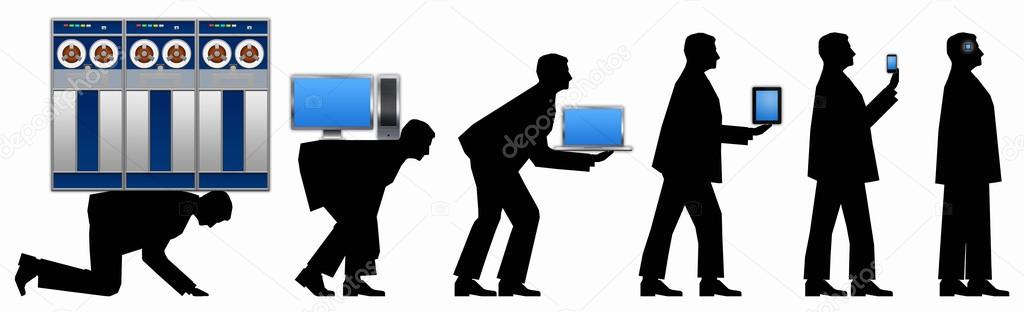
http://st.depositphotos.com/1898785/2135/i/950/depositphotos_21356099-Evolution-computer-technology-3.jpg

https://www.youtube.com/watch?v=7Nw5j6aI8sg

https://www.youtube.com/watch?v=fALEg5HtF-w

http://joaobordalo.com/files/topInternetHistory.png


Wednesday, 12 March 2014

Intro to E Business. What I have learnt so far.


As I start to write this, it occurs to me that I have not taken a breath for quite a while, see when I get anxious, the first thing I forget to do is breathe. Some might say this is an essential part of daily life and my now slightly dizzy head would agree. Deep breath in......deep breath out......

This is the first assessment of the first subject I will be studying for my Bachelor of Business Marketing. Having spent the last few years firmly focused on two small kids and a small business, study has been a world away. What I can say is that although much of the terminology in E Business is new to me, I am highly qualified in the area of Facebook, Twitter, Pinterest and Ebay having invested many hours ( for research purposes only) on such pages over the last few years.

There are eight questions I have to answer this week. For me I needed to do a fair bit of background googling before I could begin answering. So in an Idiots guide style, I will endeavour to supply some background info as I go.

1. Internet Risks. What could possibly go wrong with a transactional site? The first question I have is "What is a transactional site"?

A transactional site is essentially a website that offers an online store of sorts, included in this is online banking. Anywhere, someone can make a transaction online. It's fair to say that although we have been conducting financial transactions online for many years, the associated risks continue to be a problem.
Some of the most common risks include;
1.Security breaches, including that of theft of sensitive data.
2. Fraud
3. Identity theft
4. Limited paper trail. An example of this is when you make a purchase on Ebay, there are limited ways in which to contact the seller and with many people using avatars and often transactions are happening internationally, follow up can be challenging.

2. Definitions for E-commerce & E- business

2a. E- commerce - Business that is transacted by transferring data electronically, especially over the Internet.
2b. E-business -  electronic business, any business conducted using electronic media; any business that makes some or all of its revenue via Internet technology

3. What is the difference between buy side & sell side ecommerce?

Buy side ecommerce refers to items and resources being purchased by an organisation from it's suppliers. Sell side ecommerce on the other hand is involved in selling goods and resources to an organisations clients or customers.
An example of this is within a restaurant environment. A chef might buy raw ingredients from a local farmer (Buy side), then create a meal with said lovely ingredients and sell it to their customers (Sell side)

4. Describe the different types of eBusiness
There are many different types of ebusiness, those include;

1. B2B - Business to business - This is fairly simple it is when one business buy and sell from each other.
2. B2C - Business to consumer - An incredibly common and increasingly popular method of ebusiness. one of my personal favourites and an example of this is www.anthropologie.com
3. B2E - Business to employee - Most commonly business utilise an intranet program to offer staff products for sale, often at discounted prices.
4. C2C - Consumer to consumer - one of the most common examples of C2C is www.ebay.com.au this gives consumers the opportunity to sell to other consumers.

5. Which digital technology has the highest penetration rate? Explain & source your answer

In Australia the smart phone rivals that of the PC when it comes to having the highest penetration rate. Australia has the highest smartphone penetration rate globally, sitting at 37%. The primary driver of the increase in smart phone usage is the introduction of the Apple I Phone.


 World Wide Web Consortium Home
http://images.smh.com.au/file/2011/09/08/2611539/infographic_1.jpg[13/03/2014 12:30:17 PM]
6. List four drivers to adoption of sell-side eComerce by business

1. Reduced costs - There is no denying that by trading online, a need for large premises or staff are often minimised.

2. Increase reach to new markets - A great example of this is the option to boost posts on Facebook business pages to reach a larger audience. These boosted posts can be both broad or incredibly targeted to achieve your perfect target market.

3.Customer demand - In some cases the business can complete orders on a demand basis, saving both time and money.

4. Competitive threats - by offering an online option for your clientele, you are providing ease for purchasing and demonstrating a point of difference from your competitors.

7. Four barriers to adoption of sell side e-commerce by business

1. Security - With technology changing so frequently and fraud being a constant on everyone's radar, it is understandable that many SME's looking to make the jump to eBusiness might feel threatened by lack of security.

2. No Need - For a small business the need for eBusiness is often minimal.

3. Costs - Businesses that have been thriving for some time may question whether the costs associated with introducing an eBusiness platform will see a healthy return. On the flip side start up businesses need to count every cent they are investing in their new business and may be reluctant to part with the money required.

4. Skills - eBusiness requires a new set of skills. For many the fear of failure or fear of having to learn new skills is enough to deter them from making the change.

8. What are some examples of digital information?

To work out what constituted digital information, I needed to first find a definition for Digital information. I thought I would share that with you as well.


Digital information resources are those resources whose deal with both born digital anddigitized materials which can be either accessible from library's in house database or from the world-wide-web.

Below is a table outling various types of digital information, others relative to a university student include e books, e journals, e magazine, dissertations


Documents created using office applications:Records in online and web-based environments:Records generated by business information systems:Digital communications systems
  • word-processed documents
  • spreadsheets
  • presentations
  • desktop-published documents
  • intranets
  • extranets
  • public websites
  • records of online transactions
  • databases
  • geospatial data systems
  • human resources systems
  • financial systems
  • workflow systems
  • client management systems
  • customer relationship management systems
  • systems developed in-house
  • content management systems
  • Email
  • SMS (short messaging services)
  • MMS (multimedia messaging services)
  • EDI (electronic data interchange)
  • electronic document exchange (electronic fax)
  • voice mail
  • instant messaging
  • multimedia communications (eg video conferencing and teleconferencing

 There we have it! week one down, in week 2, now onto Navigating the web.

Thanks for reading
References

http://webserver.computoredge.com

http://dictionary.reference.com/browse/e-business

http://psut.edu.jo/sites/raad/eBusiness_notes/Chapter01.pdf

http://www.insidebusiness360.com

Rania Nemat, World Applied Programming, Vol (1), No (2), June 2011.
http://www.smh.com.au/digital-life/mobiles/australias-white-hot-smartphone-revolution

http://www.naa.gov.au/records-management/agency/digital/types-dr/index.aspx

http://www.academia.edu/260084/Definition_of_Digital_Information_Resources


Wednesday, 5 March 2014

First cab off the rank

Welcome to the exciting world of E Business. What a journey we are about to embark on. I have a blog and have been blogging for about a year now, however food and family have been my primary focus. Here we will be getting excited about the world of E Business, how successful I will be at discussing and sharing this sort of info is yet to be seen